ForgotPWAgainSigh
2025-11-20 17:06
Can't disagree. The drive is so much better compared to the original y.
spwolf
2025-11-20 17:17
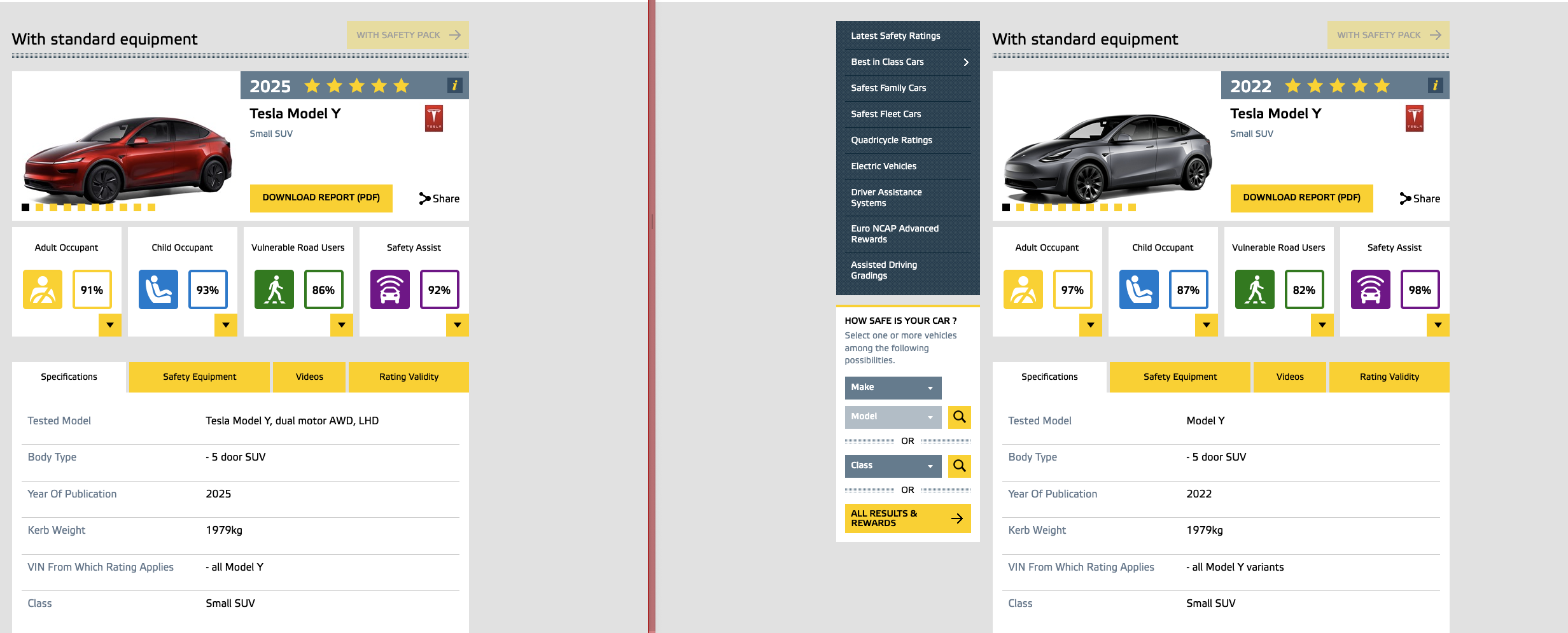
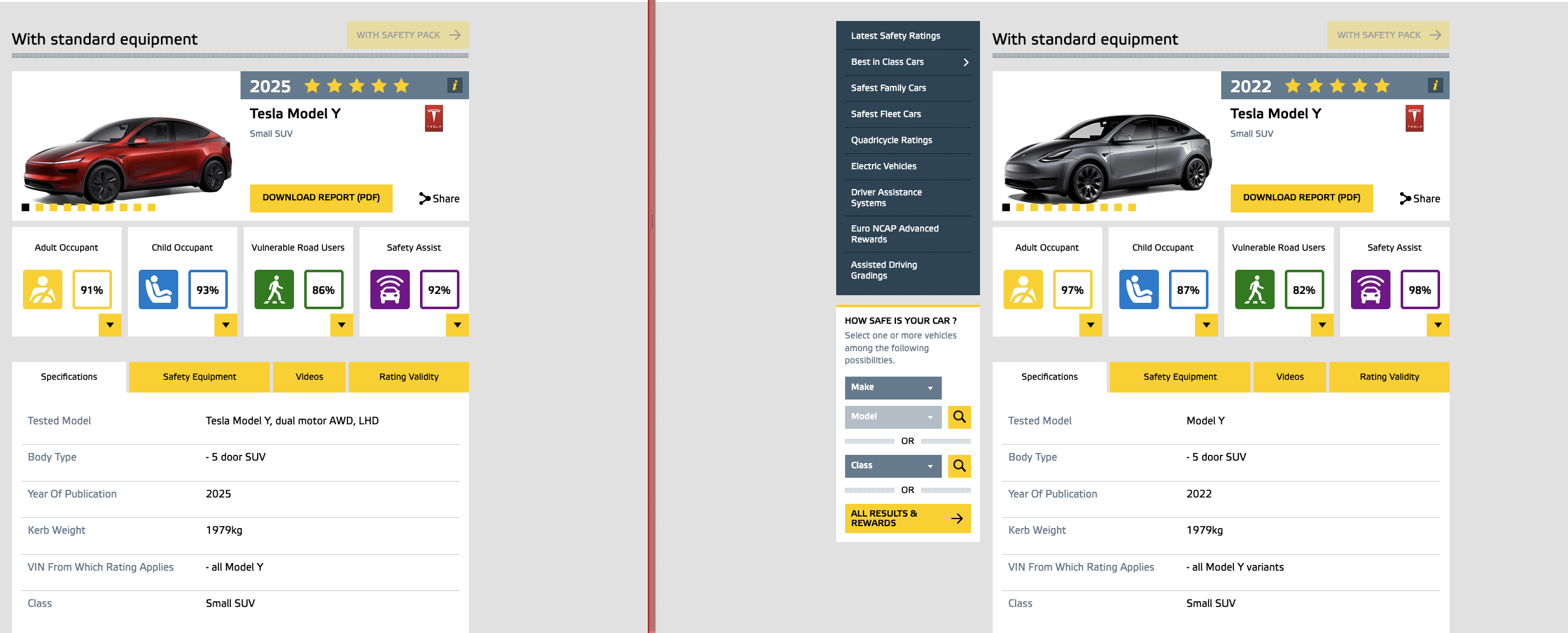
you cant compare it to old cars as safety ratings have been made more stringent several times between 2025 and 2022.
shaggy99
2025-11-20 17:29
There are different ways of assessing safety, and it's a fact that a bigger, heavier, vehicle can have an advantage, all things being equal. I like that within those limitations Tesla always seems to be trying to provide the safest cars they can for the price.
Dash------
2025-11-20 17:42
I mean you can say where on the curve of that year they are right.
But yes if Ou would test 2022 today it would most likely be worse off.
Still a stellar result all in all
DeniedByPolicyZero
2025-11-20 17:47
From a physical structural point of view it's mostly gradual minor changes since 2005 when we started seeing the first ncap 5* cars, all recent changes have concentrated on preventing accidents rather than surviving one.
You have to remember back to the pre 2005 cars and the images of crash tests to appreciate how far we came in a very short period of time around then, I remember a famous image of the Chrysler Voyager that basically just fell to bits in a crash, even tho people expected a large car to do well.
spwolf
2025-11-20 18:30
This is really not correct. There were multiple changes added to euroncap since 2005, you can see changes here but it is really wrong to think that cars structurally are the same in 2025 and 2005:
[https://en.wikipedia.org/wiki/Euro\_NCAP](https://en.wikipedia.org/wiki/Euro_NCAP)
Unfortunately since EU is composed of multiple member nations, this is all not explained well. But for instance, hew hardware test will be introduced in 2026 - **far-side impacts.**
Changes noted in 2023 tests which was last major revision:
>In Adult Occupant Protection, the penalty for poor compatibility **(the way in which a car interacts with an impact partner)** has been increased, making it more difficult for aggressive vehicles to score well. **Additional brain injury criteria have also been added to the frontal offset test.** Rescue sheets, previously required only in four languages, must now be provided in all European languages, and the assessment of post-crash technologies has been expanded. Most significantly, there is now an **assessment of a vehicle’s resistance to submergence**, measuring the duration for which critical functions such as electric window opening remain operational. Child Occupant Protection now includes an assessment of ‘child presence detection’ (CPD) - technologies which can recognise when a child has been left alone in a locked car. The **protection of vulnerable road users (VRU) now includes impact tests on those parts of the vehicle likely to be struck by a cyclist’s head**, and a **new legform impactor allows for a more realistic assessment of the protection provided to the femur and tibia**. In addition, measures taken against ‘dooring’, where a car door is opened in the path of a cyclist, are now considered. New scenarios are included in the assessment of autonomous emergency braking (AEB) systems’ response to pedestrians and cyclists. The reaction of cars’ AEB systems to motorcyclists is also introduced. In Safety Assist, driver monitoring is assessed in much greater detail than before, and the reaction of speed limit information systems to complex scenarios is extended. Finally, strict new rules prohibit a five-star safety rating for vehicles which provide no protection to any critical body region in any of the full-scale or sub-component impact tests.
Bolded hardware changes.
2020 was another major change year
>ABOUT 2020 RATING
>In Adult Occupant Protection, **there is a new frontal offset test** which assesses how well a car interacts with its crash partners as well as how well it protects its occupants. **The side barrier impact is made more severe**, with a greater trolley mass and a higher impact speed. Also in side impact, an **assessment is now made of far-side occupant protection** and the interaction between vehicle occupants in such impacts. For the first time, points are awarded for post-crash safety – the resources and accommodation made for rapid rescue and safe extrication after a crash has happened. The changed offset frontal and side barrier impacts will also influence the dynamic performance of the child dummies and the assessment of Child Occupant Protection. The sub-component impact tests for the assessment of vulnerable road user (VRU) protection remain unchanged but additional test scenarios are added for autonomous emergency braking (AEB) systems, including reversing and turning across the path of a pedestrian. In Safety Assist, seatbelt reminder is incorporated into ‘occupant status monitoring’, which also includes systems to determine whether a driver is tired or otherwise impaired. The performance of AEB systems against other vehicles, previously split between low- and high-speed assessments (in Adult Occupant Protection and Safety Assist respectively) is now combined into AEB car-to-car in Safety Assist.
>2020 assessments differ significantly from previous years and star ratings should not be directly compared with those from earlier years.
As mentioned earlier 2026 is another major year for additional tests.
I think IIHS in USA does it better by directly comparing the new and old and showing how bad manufacturers are with safety - ie they are designing for test, not for safety. Euroncap works differently and it will seldomly show the differences when new tests are introduced (and they are large).
DeniedByPolicyZero
2025-11-20 18:48
Your comments include pedestrian safety, systems to ensure car works if submerged, systems to prevent dooring (so electric systems), emergency breaking, reversing sensors etc.
The truth is nothing comes close to the absolute step change that happens in around 2005, crash survival for passengers increased massively at that time and the basic structure of the car safety cell hasn't massively evolved since then, yes slowly better, but I guess you have never seen accidents in pre 2000 cars.
spwolf
2025-11-20 18:54
We are not talking about biggest change - what I am commenting out is that you are thinking it is all the same between 2005 and 2025. It is not.
Cars from 2005 would heavily fail hardware tests in 2025.
I dont want people to have impression that driving 10-20 year cars will have no impact to their safety, because it will. Heck - T-Cross in 2019 scored 97% in front tests (just force on occupants) and its facelifted version scored 74% in 2025 - again force on occupant dummies. Back in 2019, this was best rated vehicle.
[https://www.euroncap.com/en/results/vw/t-cross/57088](https://www.euroncap.com/en/results/vw/t-cross/57088)
[https://www.euroncap.com/en/results/vw/t-cross/35883](https://www.euroncap.com/en/results/vw/t-cross/35883)
And yes, of course previously, without actual tests being done in standard way, it was mayhem.
DeniedByPolicyZero
2025-11-20 19:14
Statistics show in the EU 2002 to 2012 has a 55% drop in fatalities, but the decade after only drops another 20% (so less than 10% of the 2002 numbers).
And that it could be argued much of the 2012 to 2022 numbers are crash prevention with better electronic aids etc.
I would have a family member drive a 2010 car without much concern but I would seriously recommend against a pre 2005 car now.
ajn63
2025-11-20 19:58
Yesterday I posted a link showing crash test results of several brands of EV vehicles, including a model 3 and a Cybertruck, and the admins in this thread deleted it without any comment or feedback of why. If you want to see the results go to IIHS web site or run a search for “IIHS 2025 Electric”.
lazydesi
2025-11-20 20:10
some of the testing were undertaken at low speed environment, does the same rating applies when driving on a 100 Kmph road?
Dash------
2025-11-20 22:23
Nope, they are comparing all cars at same speeds.
epihocic
2025-11-20 23:21
But you should also tell that family member that a 2025 car is significantly safer than a 2010 car. That is the point spwolf is making.
lazydesi
2025-11-21 19:10
then these safety rankings only apply for cars travelling at that speed?
Outrageous_Fig_1235
2025-11-21 19:57
The human body can only take so much deceleration. No amount of safety features will save you from going 100 to 0 too quickly. Source: used to volunteer doing road crash rescue.
SchalaZeal01
2025-11-21 21:33
Inertia dampeners. Sci-fi been talking about them a lot, we should make some, like we made tablets out of Star Trek TNG.
*Prevents being liquefied by sudden acceleration/stop*
lazydesi
2025-11-22 19:26
I am not disagreeing what you guys are saying.NCAP should come out and say publicly he car was 5 star when tested at x kmph speed. each individual safety component has scored x when tested at y kmph
lazydesi
2025-11-22 19:29
or in otherwords, this car has X star for urban speed environment and y star for motorways/ country roads
Dash------
2025-11-22 20:27
If you will follow the link you have all videos on which the speeds are marked as well as a report that goes into this. It’s not a secret really. Also just from me watching videos you have a car vs. Wall colission, partial head on colission, partial colissions where expected result is that the other car kinda slides away from the drivers side, pole crashes, t-bone crashes etc. But yea nobody seems to crash a car with 100km/h at a wall.
A wild guess would be that if the crumple zones are disgned for those speeds, the result would be worse at lower speeds. But I do agree. For me the most dangerous situation outside of a city is a country road where there is no higway safety.
dtpearson
2025-11-23 23:54
I think you are misunderstanding what NCAP is, it's a comparison tool, this car gets 5 stars where another model only gets 4. It makes it simple for customers to make smarter purchasing decisions, and pushes carmakers to build safer cars as a result. It is more likely that a 5 star car will perform better than a 4 star car in the same crash scenario regardless of situation. 100kph or 60kph is an arbitrary variable, of which there are basically infinite permutations. They are just trying to provide comparison between models not proving what crashes are survivable in different cars, drive a Mercedes at 20kph into a truck with a long pole hanging off the back that spears you and you die at low speed in a 5 star crash rated car... in the real world there are just too many variables.
Xaxxon
2025-11-24 03:07
and gets zero stars for that awful front end.
lazydesi
2025-11-24 07:15
yes, I can completely understand what your are informing and thanks for taking your time to explain. for a comin Jo like me, is it car manufacturing responsibility to advertise that this car has scored 5 stars when tested at 50 kmph instead of this car has scored 5 stars?