BYD-backed Robosense reveals LiDAR sensor with up to 2,160 beams
CaptZee
|
2026-03-17 03:00
|
33 views
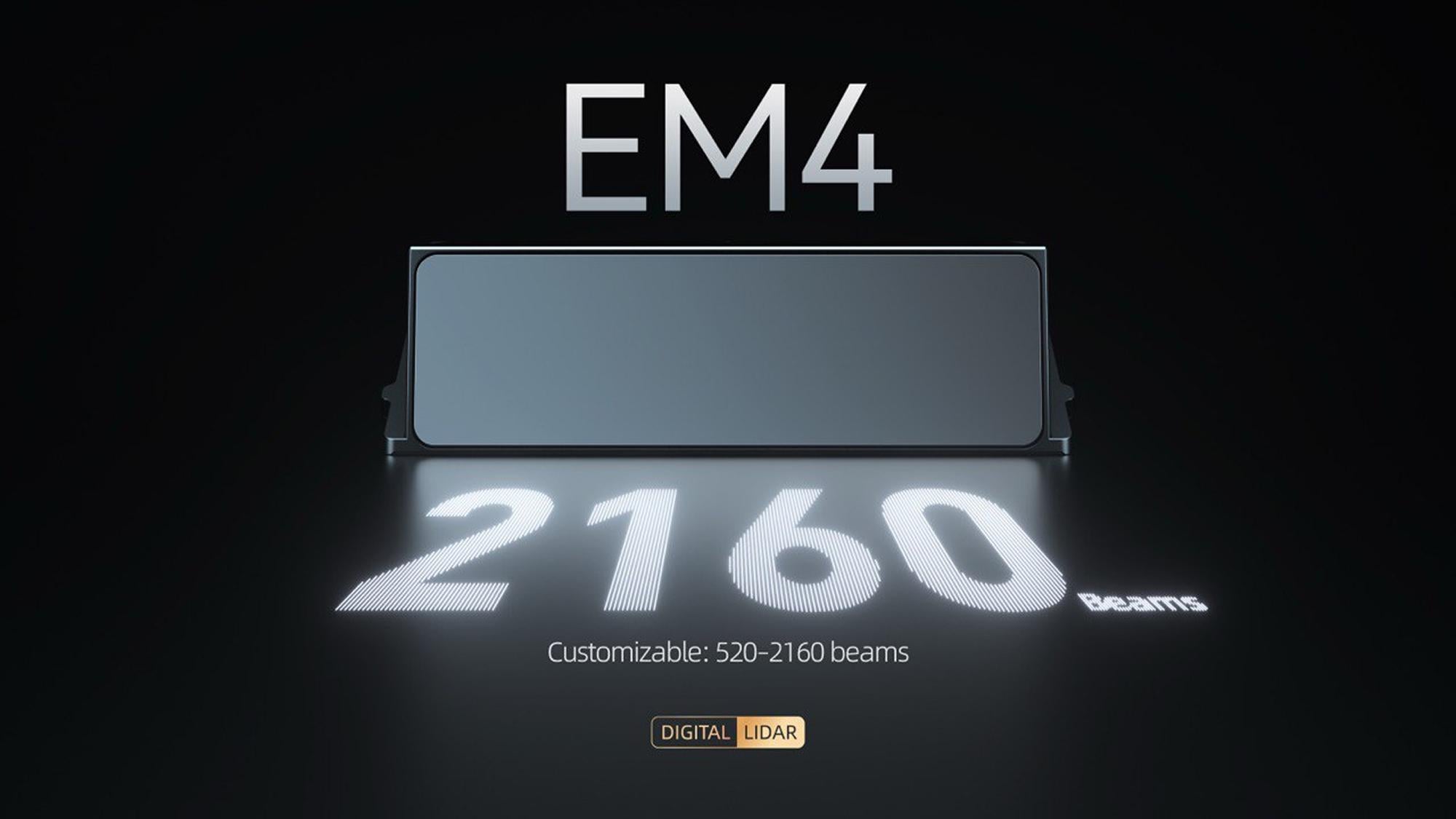
The US auto manufactures have to step up their game, quick. China is not messing around with Lidar.
I'm only partially kidding here, but why would the US manufacturers not just lobby to be able to buy Chinese lidar? They are global corporations that have repeatedly shown they care about the bottom line above all else, so if a cheap, proven system is available on their timelines, why would they not want to source it? The geopolitical issues would be a secondary concern if they can lobby their way out of them. For the record, I don't agree with this approach, but it seems like a perfectly reasonable one from their perspective assuming the quality of the point cloud is sufficient.
This is pure marketing, and why Microvision does not play the "beam" count. On paper, these look like they crush MicroVision. But "beams" are an old-school metric. Here is the \*\*"\*\*beam count book for dummies" on why the tech MicroVision is building is more competitive than the raw numbers suggest. The "mega pixel vs. Speed Radar Comparison". Think of a 2,160-beam (or higher) sensor like an ultra-high-definition 3D camera. It takes a incredibly detailed "picture" of the world. However, it’s just a "still" frame. To know if a car is moving, the car’s computer has to look at two pictures and do a lot of math to compare the difference. This creates a tiny delay (latency). Matthew Cole might have claimed when it comes to Lidar there is only one answer Microvision. However vague, Jeff Herbst in interviews pointed out its Microvisions "edge perceprion" in its sensors that stand out- way before people starting talking about it and its IP as a differentiator. Lets look at the parts: MicroVision + Scantinel (The Speed Radar): By integrating Scantinel FMCW Tech, MicroVision isn't just taking a picture; it’s using a radar gun on every single pixel. The moment the light hits an object, the sensor knows **instantly** how fast it’s moving. It doesn’t need to wait for a second "picture" to do the math. Why all the parts matter and why the integration is crucial. **Luminar Assets:** MicroVision now owns high-end 1550nm optics, which perform significantly better in rain, fog, and dust than the cheaper 905nm lasers many competitors use. **Scantinel FMCW:** This is the "4D" secret sauce. It provides **velocity-per-pixel**. In a split-second emergency, knowing the *speed* of a hazard immediately is more important than having a "prettier" 3D picture of it. **Dynamic Resolution:** Unlike a fixed 2,160-beam sensor (or higher) that wastes "pixels" looking at the sky, Mavin can shift its focus. It puts the highest density exactly where the car is going, giving it the "effective" resolution of a thousand (s)-line sensor exactly where it counts. China is winning on **volume** and **partnerships** (like Robosense being exclusive for 11 new BYD miodels. But MicroVision is building the **"Lidar 2.0"** silicon-based domestic alternative that Western OEMs (Ford, VW, etc.) need to compete without relying on Chinese hardware. I don't need to point out the geo-political reasons on this but they are **vaild**. Don't get blinded by "beam counts." A 2,000-line sensor or higher that is "blind" to instant velocity is less useful for high-speed safety than a smart, dynamic sensor that knows exactly how fast a hazard is moving the millisecond it sees it. Innovation in the U.S. often prioritizes **technological breakthroughs and long-term utility**, whereas Chinese alternatives frequently lead on **immediate scale, speed-to-market, and cost-reduction**. In the LiDAR space, this is the difference between a sensor that creates a high-definition 3D "picture" for less money (China) and a sensor that provides instant, actionable 4D data—velocity and range—to the car's computer to prevent a crash at highway speeds (U.S.). China usually wins the **consumer market** where price is the biggest factor, while U.S. innovation tends to hold the lead in **critical infrastructure and safety-first industries** (like high-speed autonomous driving) where "almost good enough" isn't an option. Which would you rather have to protect your family?
Well done 7056.
I think you are partially right in that "number of beams" is just marketing and only tells a part of the story. This is very similar to how sumit used to brag about points per second, by the way. That said, with a 27 deg vfov, that puts the EM4's vertical resolution at 0.013 deg across the entire vfov. This is better than mavin's 0.015 deg, which it only achieves using interlacing, and likely a little worse than what the Luminar sensors achieve with their foveation along the vertical axis. Regarding velocity estimation, any non-fmcw lidar, including mavin and iris/halo, will need multiple frames to estimate velocity, and fmcw lidar will also need multiple frames to estimate the tangential component of velocity. I think FMCW's instantaneous measurement of radial velocity is very useful for things like segmentation and classification, but any safety use case like the one you describe will need both velocity components, so I don't actually think FMCW has a major advantage here. I agree with everything said about 905 vs 1550 though.
Login is required to comment.
Login with Google