Fit_Evidence_4958
2025-12-13 15:44
Maybe a bit more. My car tells me a average of 15 kwh /100km, the smart socket more like 17.5 kWh. So it’s like 15%
chesq00
2025-12-13 15:45
Makes sense! I heard these kind of plugs are less efficient tho, like, a wallbox would be better, is that true?
Fit_Evidence_4958
2025-12-13 16:30
Yepp. The car has a certain steady consumption while charging, regardless which AC charger is used. So if you need for a recharge with the granny charger 3h and with a wallbox 1.5h, the car needs per charge more power for itself hence the efficiency is lower.
I did the math for me and the additional costs of a wallbox won’t compensate the less efficient granny charger.
I have the time to get the vehicle charged with only 2.4kW so works for me so far.
roflpops
2025-12-13 20:34
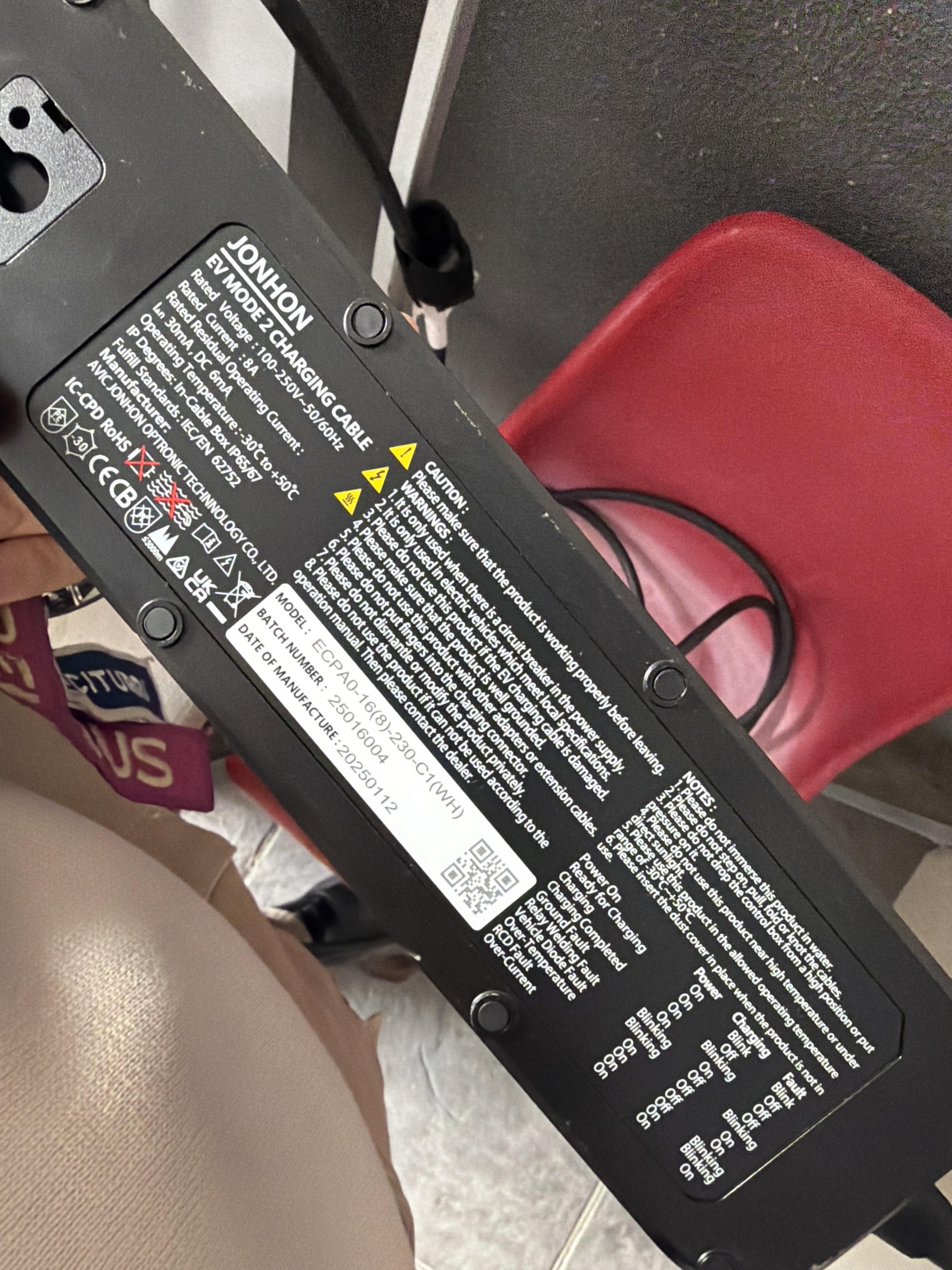
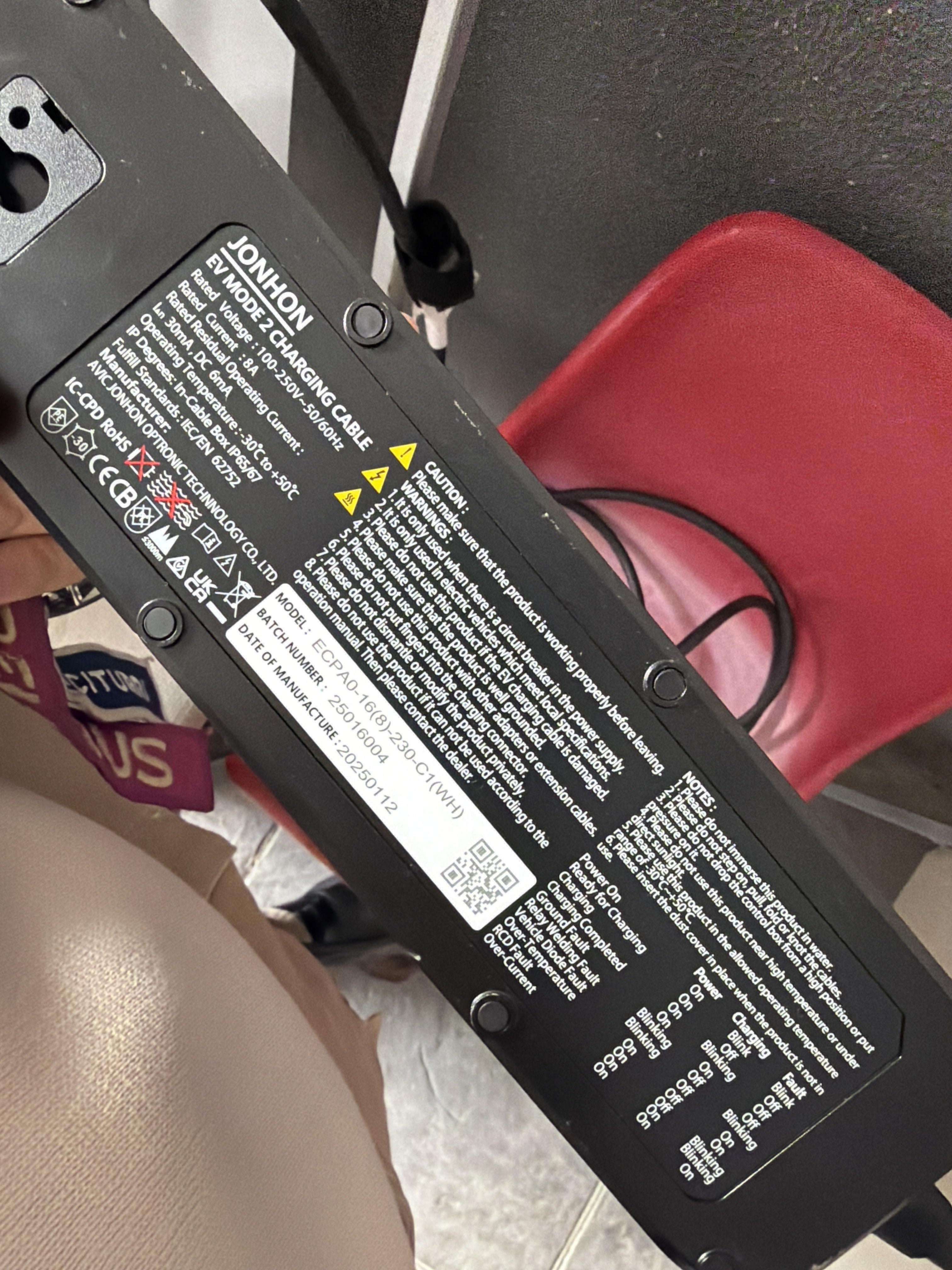
It's rated at 8amps, so what ever out output voltage is where you live. If 220v then 220x8=1760w. So 1.7kw is its maximum power consumption
[deleted]
2025-12-13 22:42
My Atto 3 charger that came with the car draws just under 2kW and the car fills up at 1.5kW
_TheMonster_
2025-12-13 23:42
+1 to this.
Initial batches of BYD cars came with 16 Amp chargers, which slowly reduced to 10 Amp (the one which I have) and now I guess they reached 8 Amp.
meoverhere
2025-12-13 23:58
0. It has no efficiency because it is just a contactor and some controlling electronics. The charger is in the car - it’s called an onboard charger.
This box - EV Supply Equioment (EVSE) uses electronics to tell the car what the maximum current it can draw is. This one will be fixed or set to one of two values if it can change. Level 2 chargers will change the value (basically a resistor).
The limiting factor is the cables and plug and what they’re rated to.
The car holds the charger. Getting a new EVSE box won’t change the efficiency but there is a certain amount of base margin so the bigger EVSE you get, the more efficient it is relative to the supply current. Eg you may get 10% loss at 8A but only 8% at 32A (for example).
meoverhere
2025-12-14 00:05
No. The charger is in the car. Getting a different EVSE will not mar a difference unless you’re looking at different capacity. There _may_ be a difference when you go bigger because some of the overheads stay the same.
meoverhere
2025-12-14 00:06
Depends on region. In Australia they only came with 8. Our circuits don’t run to 16 as a general purpose output (GPO) is only rated to 10A.
chesq00
2025-12-14 00:07
Oh, so does that mean that 1.5kwh showed in the app is 1.5 drawn from wall? Sorry if I am not understanding it correctly, I am kinda new to this.
meoverhere
2025-12-14 01:33
In short, I’m not sure.
Everyone I’ve seen posting claims that it’s 1.4kW going into the battery.
The only other theory I have is that it _is_ the amount going into the car and not the battery but that the car kW is assuming a specific nominal grid voltage.
As a case in point, my Sigen EVAC is currently showing 6.82kW at 220v while my car shows 6.3kW.
Either I’m losing ~ 500w to inefficiency or:
6300/220 * 240 (assumed nominal) = 6,872.727
For me the coincidence there is too specific to be sure either way. The car only shows the current to 1 decimal place so it’s well within the maths.
_TheMonster_
2025-12-14 02:14
I am in India.
The initial BYD Atto 3s sold here came with the 16A chargers. (2022-2023). From 2024, the Seals and Atto 3s were coming with 10 Amp.
I remember reading in reddit the above was the same in Australia? (Initial batches 16 Amp and then later batches 10 Amp; Might be wrong about this though).
meoverhere
2025-12-14 03:06
I think the initial batch here were 10 and later became 8. Out GPOs do not support a 16 amp load and wouldn’t be certified as a result.
_TheMonster_
2025-12-14 04:21
Ah okay 👍
Cool, thank you for the information
SexyDraenei
2025-12-14 19:39
the charging cable itself is essentially 100% efficient, as EVSE are very simple devices and don't do any power conversion.
All the losses happen in the car. both conversion losses and power used by the car during charging, running the BMS and coolant pumps etc.
the number reported by your app is how much is going into the battery, after efficiency losses.
To calculate the efficiency, you would need some way to measure the power being drawn from the wall.
SexyDraenei
2025-12-14 19:41
the initial BYD cars in Aus had 10A chargers, but there was a couple of incidents where people had fires or melted wires because of old wiring not being up to handling 10A continuous for an extended period. so they changed to 8A
Evie_14
2025-12-14 20:31
I have installed a shelly to count the kWh I use when charging, when the car is charging at ~1.4kW, it draws ~1.8kW from the wall.
I'm assuming those 400W are used to power onboard stuff to convert the AC current to DC.
_TheMonster_
2025-12-15 02:31
Oh okay 👍
Thank you
AccomplishedWorker40
2025-12-15 10:04
I have this measured with my smart socket and what the car shows. My smart socket measures anything between 1900 and 1950W, with Voltage around 242\~244. That gives me around 8A, so everything seems to check.
Car reports between 1.5 to 1.6kW, so I asume around 15% gets lost in charger, battery, etc. When using other chargers I can see they need between 0.5kw and 1.0kw to work, plus extra loses so that, again, checks out perfectly.