← Back to topic list

MarchMurky's Law of Tesla FSD Progress*

MarchMurky8649 | 2025-06-30 13:47 | 20 views

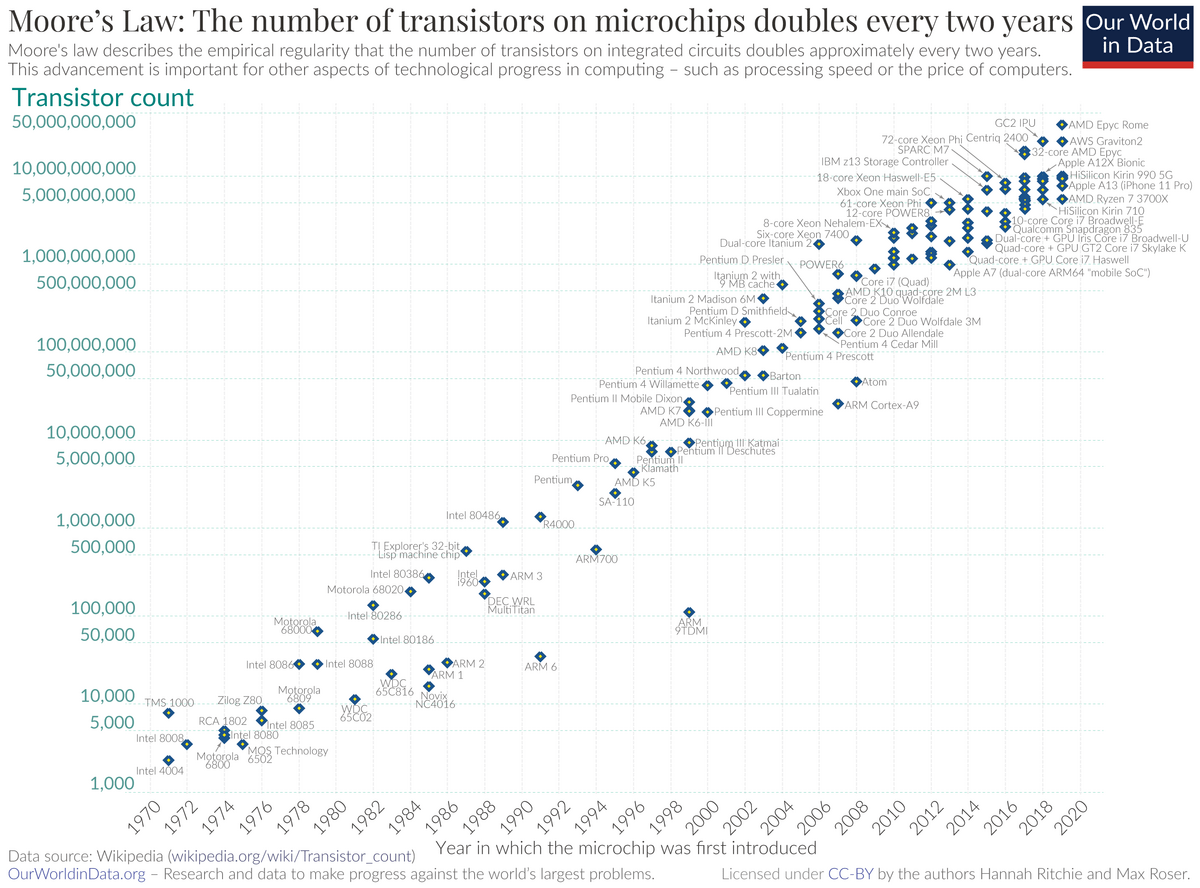
\* with apologies to Gordon Moor Here's an attempt to model the progress of FSD, based on the following from a comment I saw in r/SelfDrivingCars that I'll take at face value: "The FSD tracker (which was proven to be incredibly accurate at anticipating performance of the robotaxi) shows that 97.3% of the drives on v13 have no critical disengagements." Let's see what happens if we try assuming that development started in 2014, and that the number of critical disengagements per drive has been decreasing exponentially since then. Halving every two years seems a sensible rate to consider as it corresponds to [Moore's Law](https://en.wikipedia.org/wiki/Moore%27s_law), and this turns out to be a very good fit to the figure above. You can check this easily. If 100% of drives had critical disengagements in 2014, 50% would have in 2016, 25% in 2018, 12.5% in 2020, 6.25% in 2022, 3.125% in 2024, and in 2025 we'd expect to see about 70% of that (as .7 x .7 is approx. .5) which is about 2.2%, and 100% - 2.2% would give us 97.8% with no critical disengagements. I posit it is optimistic to model progress based on exponentially decreasing disengagements. Also suggesting development started in 2014 suggests slightly faster progress than if we used 2013 as a start date when there may have been some early work done on the Autopilot software that evolved into FSD. Finally, 97.8% being > 97.3% suggests to me that this model will give us a sensible upper bound for the rate of progress. So let's calculate [nines of reliability](https://en.wikipedia.org/wiki/Nines_(notation)) for FSD with this model. The number of drives with critical disengagements fell to < 10% in 2021 yielding **90% in 2021.** It will fall to < 1% in 2027 yielding **99% in 2027**, < 0.1% yielding **99.9% in 2034**, 0.01% yielding **99.99% in 2041**, and, similarly, **99.999% in 2047** and **99.9999% in 2054**. Note I have suggested that is an upper bound for the progress, i.e. these dates represent the earliest we might expect to see these milestones reached. The key question is, I argue, **how many nines of reliability are required** for removing one-to-one supervision to make sense? E.g. the savings in terms of salary for the chap in a robotaxi's passenger seat, likely to be in the tens, but not hundreds, of USD per drive, plus the positive PR value of truely unsupervised operation, exceeding any financial liability, and negative PR, from any incident resulting from the lack of one-to-one supervision in the case of, or inability to make, a critical disengagement, e.g. a crash. The reason I suggest this is the key question is, because, I posit it is obvious that **while one-to-one supervision is in place robotaxi cannot make a profit** as the supervisors will be paid at least as much as a taxi driver, or delivery driver in the case of trying to save money using robotaxi to deliver cars to customers.
Comments (10)
adamjosephcook 2025-06-30 14:07

The fundamental problem with a purely data-driven analysis on this is that data alone, and especially data from uncontrolled sources, cannot capture a full accounting of failure pathways. Data is a vital part of a safety lifecycle. But it is not complete. That has been **the** flaw in Tesla’s thinking, even though it was never done in good faith. As these systems *appear* to become more reliable, it could equally be true that unsophisticated human operators are simply becoming more complacent - not having insight into the black box of the system. And, thus, missing potential failure modes that can have an outsized impact somewhere down the line. It is a classic issue in any safety-critical systems development process - and something called a Safety Management System (SMS) is designed to combat these natural human tendencies in evaluating systems under development and the systems once deployed. As to how many “nines of reliability” that are sufficient… Really, the question there is… how cheap can the safety lifecycle maintenance costs be in order to marginally satisfy the **vibes** of the public? The concept of safety has always been vibes with the public and, hence, there has been little demand for much of any regulation. Incidents are distributed over space and time so the US public is generally comfortable with ~40,000 roadway deaths annually. Maybe even two times that. Maybe even three times. No one can say for certain before it becomes a campaign issue. However, so far, the vibes of the public seem to hold self-driving cars to a much higher standard than human-operated cars. Unfair perhaps, but it is what it is. Any developer of safety-critical systems should know the score. The public is fickle. Irrational. But little can be done. So the answer on the reliability sufficient - and those ultimate costs (and who exactly bares those costs and how they are distributed) - is going to be a wide open question right now.

Red-FFFFFF-Blue 2025-06-30 15:34

What about AI supervision?

Charming-Tap-1332 2025-06-30 16:05

A problem I have is with Elons' messaging that claims the present state of FSD is already "safer" than humans. My very topical analysis of this claim is sort of scary when you take a look at how many automobiles have been involved in an accident. I've used several online used car sites (CarGurus, Cars, and Autotrader) to learn that over a 10 period of a particular model (Toyota Camry or Honda Accord) that 40% to 45% of these vehicles had been in some type of "Carfax recorded" accident. So, my conclusion from this is that benchmarking your product (FSD) against humans who apparently fail >45% of the time is not the "selling point" or "flex" he thinks it is.

MarchMurky8649 2025-06-30 17:19

The supervision I am talking about is that part of the process AI is unable to achieve. If AI can fulfill the responsibilities currently being performed by an employee in the passenger seat, the door is opened to Tesla making money from their robotaxi service. I am trying to work out when that will happen.

bobi2393 2025-06-30 17:47

I think you may be overly pessimistic by treating critical disengagements as a showstopper, needing to be reduced to 0.00001% of rides or something. Some would result in severe accidents, but if there were no driver, some disengagements might be handled with marginally greater risk by more tenacious software, and some might be handled by remote operators. Waymo relies on remote assistance a lot, and some of those situations would be kind of equivalent to some FSD critical disengagements.

MarchMurky8649 2025-06-30 18:11

I was, in fact, deliberately vague about this aspect, hoping someone would pitch in with a way to assess critical disengagements in the context of 'showstoppers' when trying to determine how many nines are enough. For example, if one in a hundred critical disengagements, in the context of some teleoperational supervision, albeit, perhaps, many-to-one, leads to an accident causing damage or injury, and if six nines are deemed the bar for that, then four nines would suffice for critical disengagements. Someone on r/SelfDrivingCars made [a very useful contribution](https://www.reddit.com/r/SelfDrivingCars/comments/1lo7o3f/comment/n0kxhqt/?utm_source=share&utm_medium=web3x&utm_name=web3xcss&utm_term=1&utm_content=share_button) attempting to justify an approximately one in a hundred figure for this ratio. I recommend reading that, and some of the other, comments on that subreddit's version of this post, as there have been many interesting contributions. Thanks for your input :-)

bobi2393 2025-06-30 20:59

I think it's too apples-to-oranges to extrapolate data from Waymo's [2020 Safety Report](https://storage.googleapis.com/sdc-prod/v1/safety-report/2020-09-waymo-safety-report.pdf) for anything related to Tesla Supervised FSD in 2025. The only reference to disengagements I see in Waymo's report seems to mean disengagements *by a human safety driver*. I think it would be better to pick some fairly arbitrary number that feels right to you, like 99.999% of FSD-initiated disengagements would not result a collision, and just state that as an unsupported assumption as part of your analysis. The real percentage, whatever it is, would change over time, just as the number of disengagements per mile driven change over time, but for really rough napkin-math discussions, I'd assume a constant average collision-per-disengagement percentage.

MarchMurky8649 2025-07-01 00:51

Recent Twitter exchange: Farzad @farzyness Hey @elonmusk - when does Tesla expect to get to a 3:1 or more Robotaxi to Supervisor/Teleoperator ratio? Per my modeling it looks like Robotaxi is about break even at 2:1, very profitable at 3:1, and wildly profitable at 5:1 and above. Would be super helpful - thanks! Elon Musk @elonmusk As soon as we feel it is safe to do so. Probably within a month or two. We continue to improve the Tesla AI with each mile driven. If these two are both right, Tesla Robotaxi will be very to wildly profitable within a month or two. Thoughts?

Few-Masterpiece3910 2025-07-01 03:05

Humans don't fail at 50%. 50% fail once in 10 years.

noelcowardspeaksout 2025-07-01 05:19

I think they will have to look at how critical the interventions by the assistant driver were in terms of safety. In general SD cars aim to beat humans for safety with less than 1 death per 100 million miles.

Add comment

Login is required to comment.

Login with Google